Code Generation
By default, the server compiles a delegate for each webservice method that fetches the input
arguments from the request, executes the method, and maps the result into an HTTP response -
this is faster than analyzing and invoking the method via the reflection APIs on every request.
The delegate is compiled once, during PrepareAsync (i.e. server start), so it does not add any
latency to the first request handled by the endpoint.
Code generation is not supported on ARM-based CPUs due to limitations of the .NET framework on this platform. As code generation is performed at runtime, this mode is not available for AoT apps. The service framework will automatically fall back to reflection in affected environments.
Choosing an Execution Mode
Code generation is used automatically wherever supported (ExecutionMode.Auto, the default). To
force plain reflection instead - e.g. while debugging a code generation issue - pass
ExecutionMode.Reflection to the framework handlers.
Webservices
using GenHTTP.Engine.Internal;

using GenHTTP.Modules.Layouting;
using GenHTTP.Modules.Practices;
using GenHTTP.Modules.Reflection;
using GenHTTP.Modules.Webservices;

// http://localhost:8080/my/

var api = Layout.Create()
                .AddService<MyService>("my", mode: ExecutionMode.Reflection);

await Host.Create()
          .Handler(api)
          .Defaults()
          .RunAsync();

public class MyService
{

    [ResourceMethod]
    public string SayHello() => "Hello World!";

}
Functional
using GenHTTP.Engine.Internal;

using GenHTTP.Modules.Functional;
using GenHTTP.Modules.Practices;
using GenHTTP.Modules.Reflection;

// http://localhost:8080/

var api = Inline.Create()
                .Get(() => "Hello World!")
                .ExecutionMode(ExecutionMode.Reflection);

await Host.Create()
          .Handler(api)
          .Defaults()
          .RunAsync();
Controllers
using GenHTTP.Engine.Internal;

using GenHTTP.Modules.Controllers;
using GenHTTP.Modules.Layouting;
using GenHTTP.Modules.Practices;
using GenHTTP.Modules.Reflection;

// http://localhost:8080/my/say-hello/

var api = Layout.Create()
                .AddController<MyController>("my", mode: ExecutionMode.Reflection);

await Host.Create()
          .Handler(api)
          .Defaults()
          .RunAsync();

public class MyController
{

    public string SayHello() => "Hello World!";

}
Benchmarks
The code generated for a service method is highly optimized to directly read values from the request,
similar as you would do it in a handwritten IHandler instance. Nevertheless, the routing required
to find and invoke the requested service method adds a small overhead. The following table shows the
performance of the different modes. As there were a lot of improvements when the code generation
feature has been added to the reflection module, there is also a comparison to version 10.3 without
those optimizations.
| Mode | Requests / s | Result |
|---|---|---|
| Native Handler | 123,031 | 100% |
| Code Generation | 121,465 | 98.7% |
| Reflection | 118,230 | 96.1% |
| Reflection (10.3) | 115,157 | 93.6% |
Error Handling
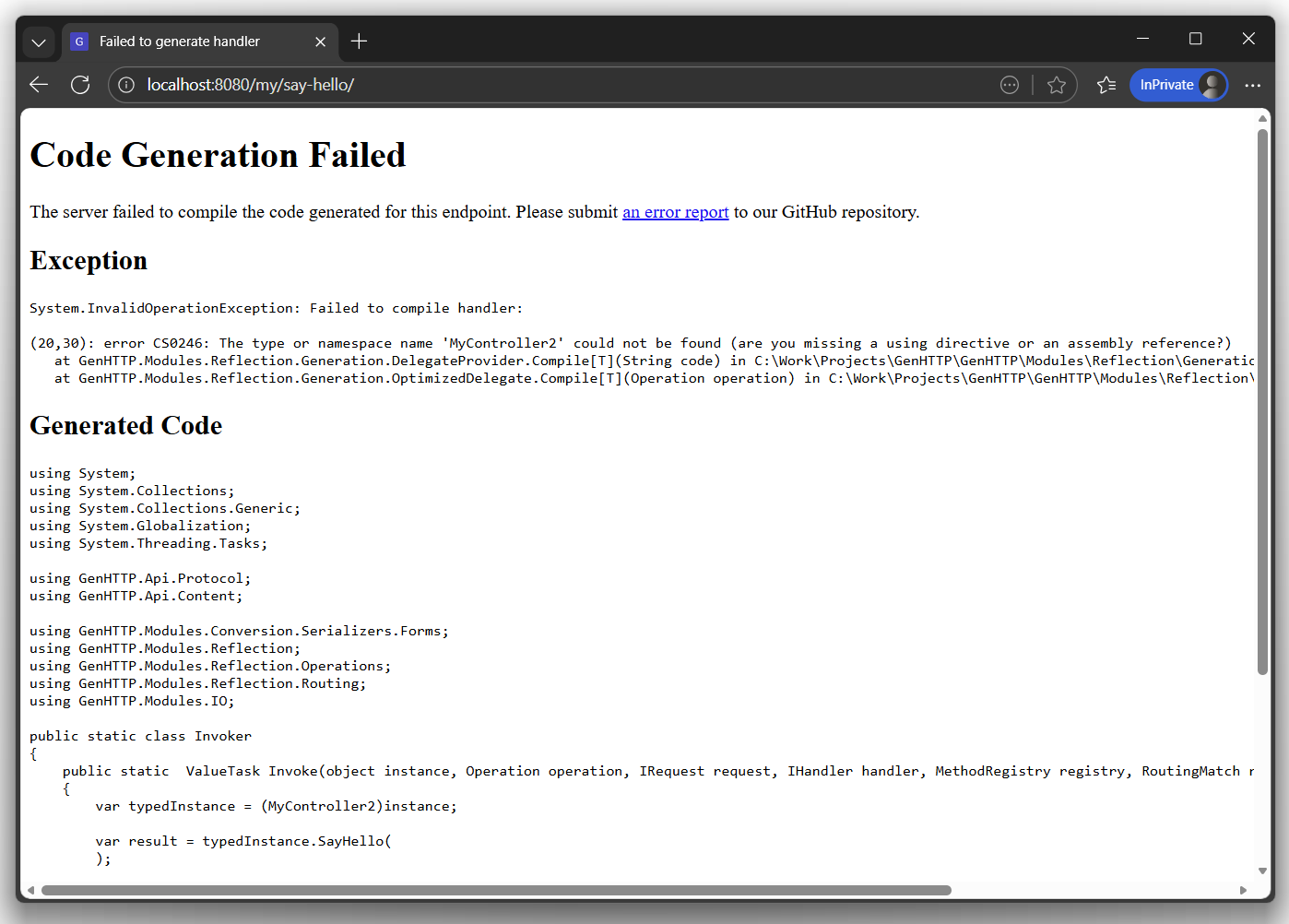
If the server fails to compile a delegate for a given method signature, an error page will be rendered when the corresponding endpoint is called. If you encounter such an issue, please report a bug to our GitHub repository.